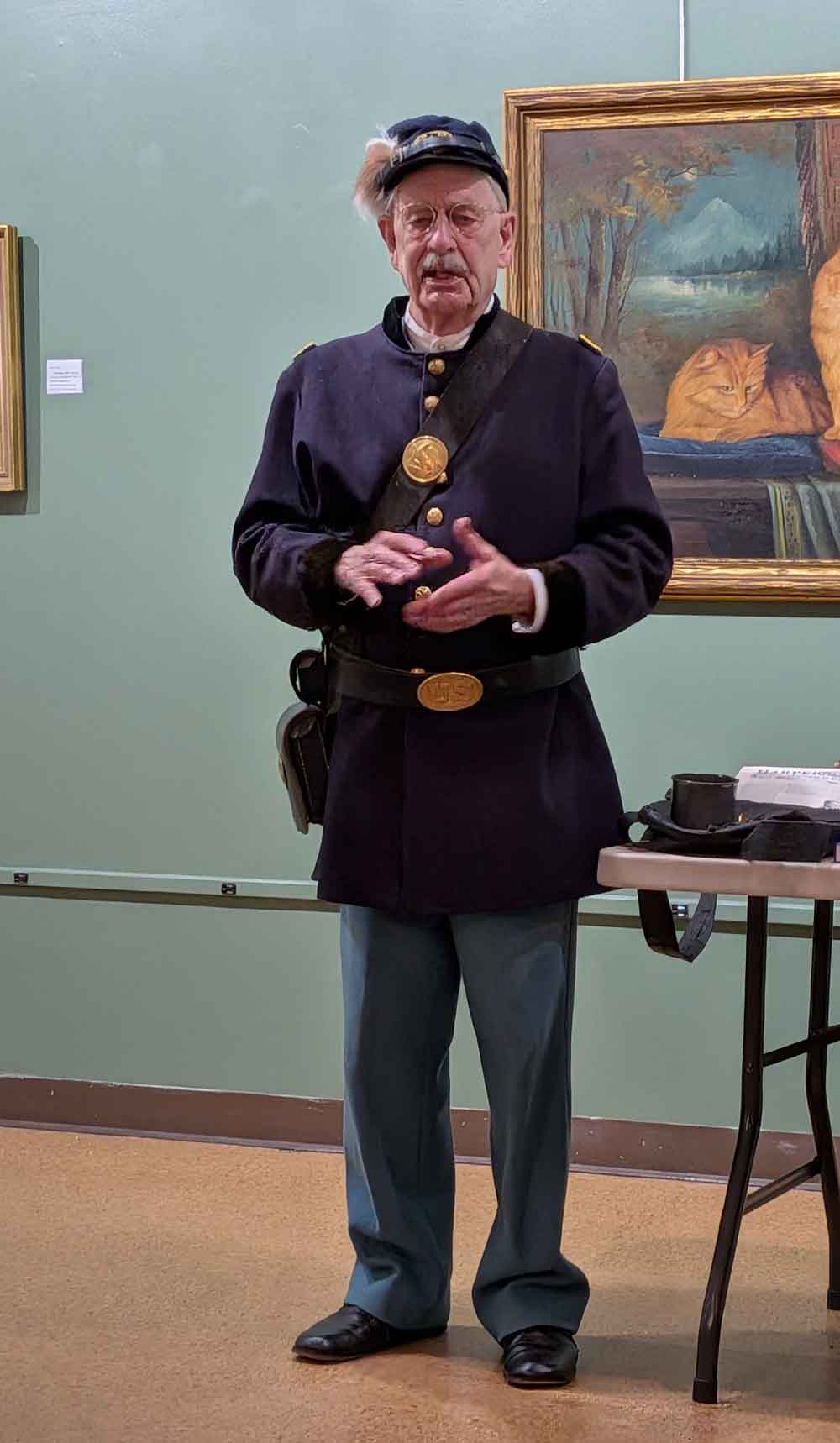
 The Taber Museum hosted a Coffee Hour on Thursday, August 13, 2026, with an appearance by Chaplain McCormick of the Pennsylvania Bucktails. The Bucktails first formed in April 1861, when Thomas Kane sought permission to raise a company of riflemen from men of McKean County. The men wore civilian clothing, but sported a buck’s tail in their hats, a visible symbol of their expertise at marksmanship. Chaplain McCormick is portrayed by the Reverend John Lee.
Chaplain McCormick was of Irish extraction, born in 1818. He was a Methodist minister, who wrote rode the circuit.
He was speaking to us as though it was 1894 and he had traveled as an old man to tell his story. He wore his uniform. He said that the reason he did it was vanity, that the uniform still fit.
He joined the Bucktails in 1862, as infantry. Initially, his unit was assigned to Washington, DC to protect the President at his summer residence. The unit appreciated that assignment because Mary Todd Lincoln would bake them cookies. However, Washington was not a good place to live as it was hot and muddy and unpleasant.
They were then reassigned. They traveled to Chancellorsville and they were involved in the battle there. He recalls that there was a great deal of anger after the battle as there were tremendous losses on the Union side, and the men blamed it on poor leadership.
He was finally promoted to chaplain, which he didn't do initially because he hadn't been preaching at a regular assignment. As a chaplain, he performed many responsibilities, but one of them was to write to the families on behalf of illiterate men. He would also read letters to them. Most of the history we have of the Civil War is from these letters, which were generally unbiased and unvarnished.
From Chancellorsville they marched toward Gettysburg. He recalls that the summer was extraordinarily hot and he described the wool coats that the soldiers wore, so that heat and sun related illnesses were common.
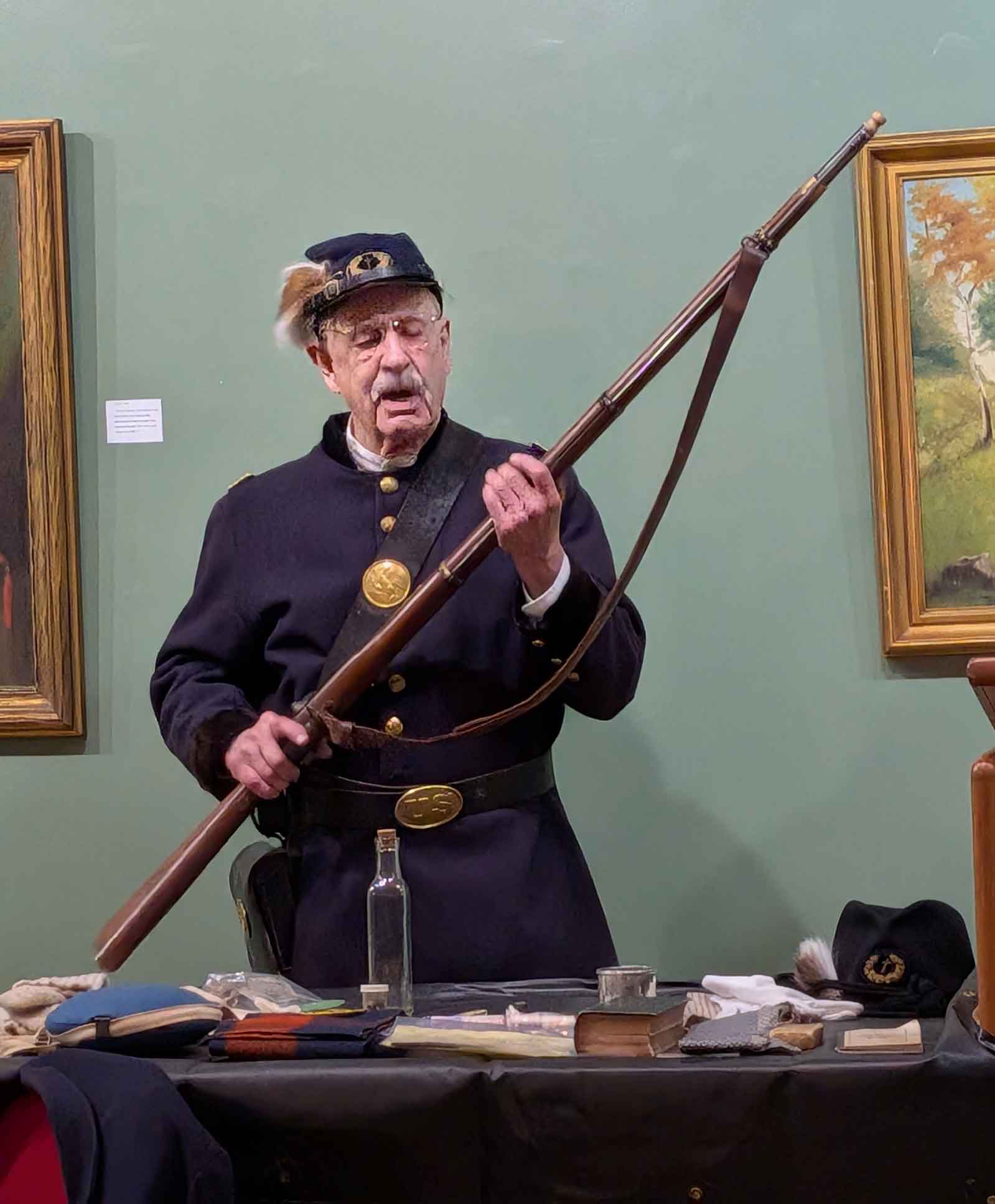
As a chaplain, he was not required to carry a gun but he had carried one before he was promoted, so he continued to do so. He had a replica of the gun that would have been used in that time. Note that the gun was manufactured by the British and the British made money selling to both sides.
He described the battle at Gettysburg where they lost 75% of their unit. He described one chaplain who had a high-end rifle and was an excellent marksman. He would apparently shout a blessing aimed at the opposing soldier before he shot him. Another, a Catholic priest, would stand before his men (the Irish brigade) and grant them absolution before the battle. Although he was unarmed, he was never injured. A most difficult aspect of a chaplain's work was dealing with the many dead. One thing that they would try to do is write down the name of the deceased and put it in a glass bottle to be placed with the body so that I could later be identified.
In 1864, he received a medical discharge and returned to farming and also selling sewing machines. He continued to do a occasional pastor's work, including marriages. He died in 1896.
The Lecture Series which continues throughout the year is sponsored by Catherine Burns Insurance Services, Muncy. As well, the Series is co-sponsored by a Travel and Tourism Grant from the Lycoming County Visitors Bureau. The Lecture Series features a number of exciting programs and reenactors to celebrate the history and heritage of the country’s 250th birthday.