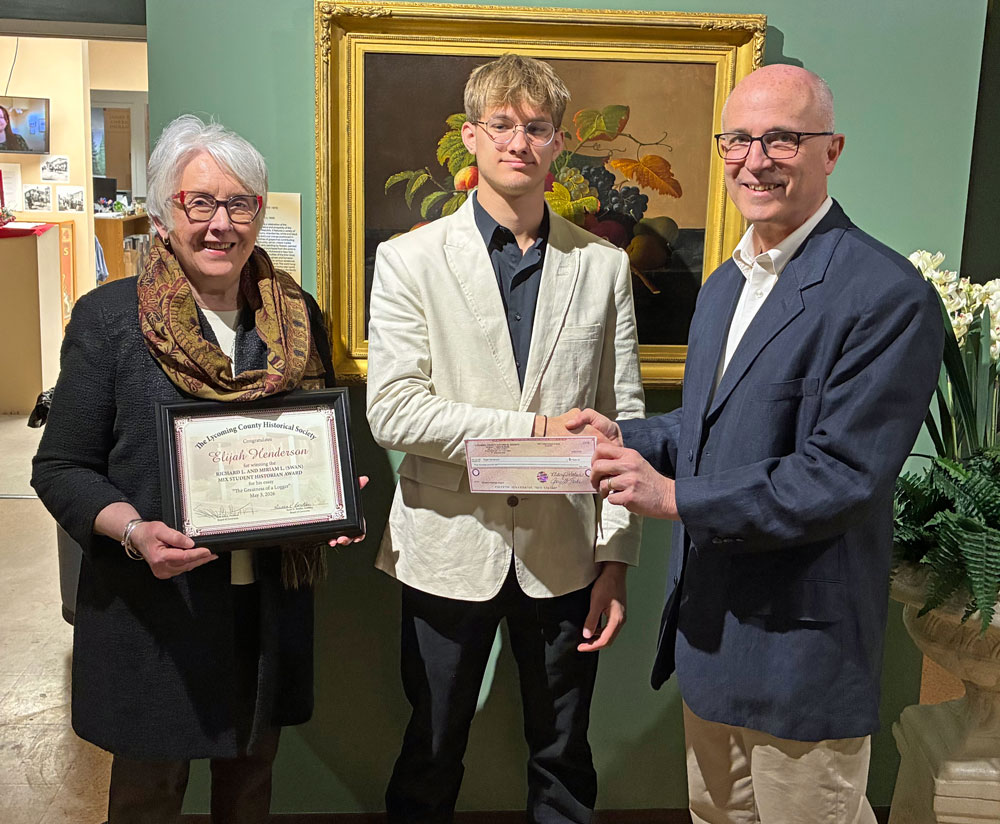
The 2026, Richard L. and Miriam L. (Swan) Mix Student Historian was presented at the May 3, Lycoming County Historical Society annual membership meeting. Elijah Henderson, of the Williamsport Christian School, was the winner of the award and the $500 scholarship that went with the honor. His essay is reproduced below.
The competitive contest invites seniors attending schools in Lycoming County to submit an 800 to 1200-word essay for which the student selects a gallery at the Taber Museum and writes a first-person essay about the student's life, while imagining themselves in the gallery. The submissions are judged by a panel of teachers and historians on historical accuracy, originality and writing style.
Congratulations to Elijah.
The Greatness of a Logger By Elijah Henderson
February 27, 2026, Williamsport Christian School
At the end of each day, I sat and soaked in the fading colors of the fiery sunset scattering over the graceful mountains. As I took time to see the beauty of the quietly dramatic Pennsylvania landscape, I could feel the thin air and frosty mist. The sweet sap and strong scent of earthy wood reminded me of my years past when I spent my days running through these wooded hills making memories. It was January, 1875, prime time for cutting down trees. The ground was fragile like ice and the snow let each log glide over the earth like skis on powdery slopes. I woke up before dawn to my trusty hound licking the bottom of my feet, knowing I'd wake up to feed him. Even though my toes were freezing and my nose felt like it was going to fall off, I knew I must eat breakfast and remain moving to keep myself warm. I heated up some delicious salted pork and bea);ls and enjoyed a boiling cup of black coffee. When I was done eating, I layered up and put on my warmest wool clothes; then, I made my way up to fell my first tree of the day.
I stepped out onto the pile of logs felled the day before and looked out into the valley. I could only imagine how far the line of logs actually followed all the way up the Susquehanna river. They stretched farther than my eyes could tell, each marked with a unique symbol. Each symbol tells everything about the logs. They told us loggers what sawmill the logs belong to, who will receive the main profit, and if my labor will earn a day's pay. I learned each of those symbols like every other man I knew, by repetition and out of necessity. They were engraved in my mind like scripture. Passed down from generation to generation, this trade was now in my hands and I held the future of Pensylvanian lumber. It was men like my fathers that made this great county the greatest lumber capital of the world.
I worked fast and with great diligence. Log after log, I kept swinging and continued on. The days didn't wait. The hours passed like the swift current of a great river. This thought rushed through my mind every day as I watched the great Susquehanna carry each log to shore to be taken in by the sawmills in the valley. I heard the dull rhythm and whining blades of the mills as they turned the logs into lumber.
Williamsport is not nearly the same as the time when I ran down mud paths and through wooded groves. Those paths are now brick streets lined with grand houses made from the same lumber I risked my life to produce. Straight down what is now West Fourth Street, I walk past those houses with stained glass and wide porches on my way to work sometimes. It feels like a new era, with towns filled with the wealthiest of men, streets now called Millionaires' Row, and the mountains becoming more barren each day. Still, I go home every night to the same room that smells like smoke and coffee, and I don't complain. Work provides and the sunsets remain as beautiful as ever.
The tools of my trade now rest peacefully in a gallery displayed for others to see. Many look upon the work I had accomplished and see the instruments I used to shape it, but nothing can replace what I felt there; no photograph can capture the majesty of the mountains or the scent of the trees, and no story would restore the days I had spent pouring my heart into the land which would be known as Lycoming county.
I stand here in strange silence looking past the barrier at the display that resembles so closely the life I knew. I can almost feel the weight of each tool i;n my hands. My attention was pulled straight to the axe leaning up against the wall, just like the one I swung every day for years on end. I can feel the calluses in my palms as I imagine holding it once more. All these tools were worn, polished by time, refined by use, each telling its own story. Every knick, every scratch, every detail told about its life. These tools are not decorations. They are survival.
Through the halls and out the door of the museum the great rolling hills and billowing mountains still split each valley of Lycoming County. They are different now. No longer full with lushness and thick forests, the mountains stand gentle and thin, but they still stand. They still direct the roaring river, and they still hold the heart of Pennsylvania. At the end of each day, the sunset still scatters through the trees, and the landscape is still ever so beautiful. In 1875, I watched with an aching back and sore arms, but today I remember it while I look beyond this glass at the history of what the greatness of a logger means.