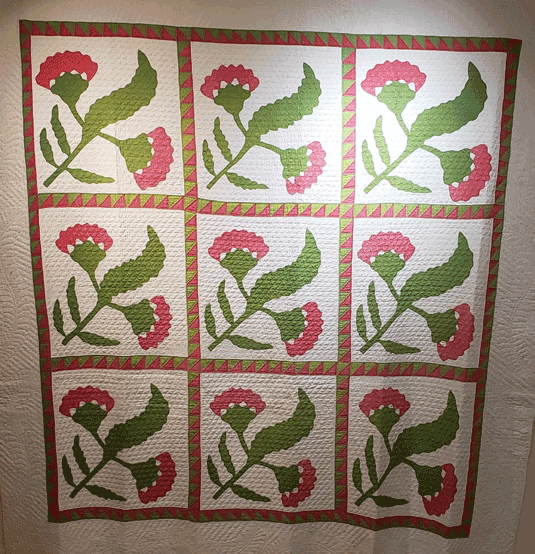
 Red is a primary color, used in all sorts of art, in this case textiles/ quilts. In the second quarter of the 19th Century a reliable red dye for fabric became available, and from then on red was a much-chosen color for quilts.
Red shows up in botanical applique as flowers with overdyed green leaves on a white background in a style that somewhat mimics the fanciful designs of the German frakturs. Redwork embroidery became popular in the late 19th Century outlining scenes of Kate Greenaway-style children, animals and other subjects on “penny squares” of muslin fabric. Redwork was also used well into the 20th Century to embroider over signatures on all manner of quilts for churches, schools and other institutions, some as fund-raisers. In fact, a vast number of signature/ inscribed quilts seem to be red and white. And, throughout history we find red and white as the palette for many pieced quilts.
Why red? The color of love, valentines, symbolizing the heart and everything meaningful. We can only surmise that red’s association with love is the reason it was used so often.
The Taber Museum’s textile team (Ricki Moler, Patti Winters, Eloise Bennett, Christine Sperling, Cindy Craddock, Kim Hunter, Nancy Jacobs, with help from Carol Shetler) has dug deep into the LCHS Textile Collection to find seldom-seen examples of quilts that feature the color red. This special exhibit of 19 quilts will run from December 4, 2026 to January 23, 2027. Plan on attending the opening reception for Taber members on December 4 from 5:30 to 7 pm; for the general public from 7 to 8:30 pm, same date (in conjunction with the Ornament Sale).